
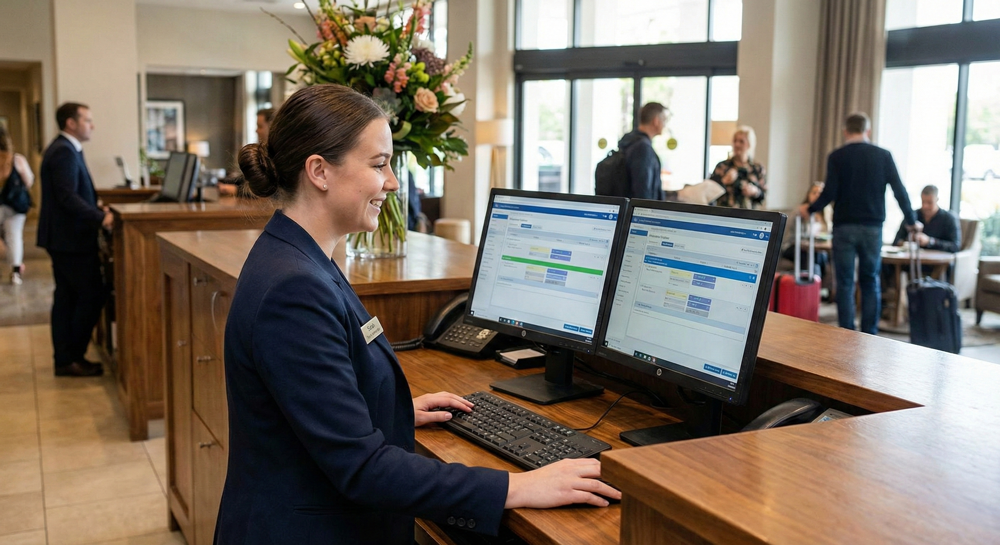
When the amenities budget tightens, the danger is not spending less. The real danger is cutting in the wrong place and removing the details that create a sense of care, comfort, and control.
A smart approach protects two realities at the same time: the guest’s emotional experience and operational performance. The goal is simple: reduce the cost per occupied room without increasing friction, complaints, or the perception of a downgrade.
1) Starting point: the guest does not judge each expense, they judge moments
Guests do not remember the price of a sewing kit. They remember whether the room feels reassuring, clean, and consistent with the rate. If something feels low end, poorly maintained, or questionable in terms of hygiene, the experience starts to crack.
Satisfaction studies and analysis remind us that cleanliness and perceived value remain major drivers. J.D. Power highlights cleanliness as one of the main levers of room satisfaction, and ranks staff service among the highest rated factors.
Analysis based on guest comments also highlights cleanliness, service, and value as dominant elements in the overall evaluation.
So the right question is not “what do we remove?” but: what creates trust, and what is simply cost and noise?
2) A simple framework: Frequency, Friction, Proof
To decide where to invest, evaluate each area using three criteria.
A. Frequency (how often the guest touches the element)
Very frequent: towels, sheets, soap, shampoo, body lotion, slippers, water, coffee, welcome elements.
Low frequency: stationery, gadgets, rarely used accessories.
B. Friction (how quickly it triggers a complaint)
High friction: hygiene, comfort, performance. A scratchy towel, a tired robe, toilet paper that is too thin, a product that does not lather, a bottle that leaks.
Low friction: small extras that are not expected.
C. Proof (visibility in photos and reviews)
What is seen and commented on carries a lot of weight. Online reviews influence choice and performance, and research shows that attributes and amenities can affect ratings differently depending on hotel category.
Rule of thumb: invest where Frequency + Friction + Proof are high. Simplify elsewhere.
3) Where to invest: “skin contact” and the “first minutes”
A rule that almost always works: invest in what touches the skin and in what the guest sees immediately.
Bathroom (quality before quantity)
Guests judge sensory performance: lather, fragrance, texture, feel when rinsing, and feel on the skin. Research on the perception of hotel toiletries highlights the importance of criteria such as lathering ability and a relaxing scent for shampoos, and a non greasy, moisturising lotion with a soft touch.
Budget implication: you can reduce the number of items, but the essentials must be genuinely good.
Textiles that signal comfort and care
Towels, bath mats, robes, slippers, bed linen. This is tactile proof of quality and links directly to perceived cleanliness. Luxury benchmarks emphasise impeccable presentation and elements that strengthen the perception of luxury and value.
Welcome details that reduce stress
The first ten minutes often determine whether the guest relaxes or starts looking for faults. Fund the basics that remove irritants: easily accessible water, clear information, functional lighting, simple charging, and tea and coffee presented neatly.
4) Where to simplify: remove the “extra”, not the “comfort”
Here are simplifications that are generally safe, as long as your base remains premium:
Remove duplicates
Two vanity kits, multiple cards, too much stationery.
Reduce the number of references
One premium core set + an upgrade layer (suite or VIP) often costs less than managing too many average variants.
Move some items “on request”
Ask housekeeping and reception what is actually requested. If nobody asks for it, stop auto placing it.
Standardise formats and packaging
Fewer different formats means less complexity and fewer stockouts.
5) The main lever: packaging and durability without losing trust
Refillable systems and bulk formats can reduce costs and waste, but only with a high end execution: quality dispensers, clear hygiene protocols, coherent design, and a premium feel.
Research into environmental practices in hospitality shows that acceptance of “sacrifices” and willingness to pay more depend on context, attitudes, and how the trade off is presented.
Translation: do not sell sustainability as removal. Sell it as a system upgrade, with no doubt around hygiene.
6) A concrete budgeting method you can apply quickly
Step 1: map the journey
Arrival, bathroom, bed, workspace, refreshments, night preparation, departure.
Step 2: define your non negotiables
Anything that influences perceived cleanliness, “skin contact” comfort, and first impressions.
Step 3: create two categories
- Base: coherent premium essentials across all rooms.
- Upgrade: 1 to 2 signature elements for suites and VIPs, not an accumulation.
Step 4: replace “more objects” with “better execution”
Less, but better presented, better felt, and better maintained.
Step 5: measure
Cost per occupied room + keywords in reviews (cleanliness, bathroom, comfort, value). Review dynamics can strongly impact performance, especially in upper segments.
7) Quick memo: “invest vs simplify”
Invest: textiles (bed and bath), performance of core toiletries, robe and slipper quality, hygiene presentation, anything touched daily, anything that shows up in photos.
Simplify: duplicates, rarely used accessories, excessive stationery, too many variants, auto placement of niche items, complex mixed packaging.
The right amenities budget is not about cutting at all costs. It is about trust: a room that feels intentional, clean, comfortable, and consistent with the rate. By protecting high impact touchpoints and simplifying the rest, you reduce costs without damaging the experience.

Let's create a world for your guests together
Download Catalogue
Learn more about creating your accessories with us by downloading our catalogue. To download it, please enter your details below to access it.








DOWNLOAD CATALOGUE BY SUBSCRIPTION
DOWNLOAD CATALOGUE BY SUBSCRIPTION

ADDRESS
Chemin du Suchet 2
1805, Jongny
Switzerland
+41 21 652 05 09
info@lgbusiness.com